Federal Funding Guide
How to Find Federal Grants and Government Contracts
$2.5 trillion in federal funding flows to organizations every year. Most of it is invisible to you. Here's exactly where to find it, how to evaluate it, and how to win it before your competitors do.
The $2.5 Trillion That Most Organizations Never See
The U.S. federal government spends approximately $2.5 trillion annually on contracts, grants, and funding programs. State and local governments add another $500+ billion. Most organizations have no idea how much of this funding could belong to them.
Consider this: Your organization might be perfectly qualified to win a $2M federal contract. The government is actively looking for exactly what you do. The funding is allocated. The solicitation is posted. But your team doesn't see it. A competitor does. They win. You never knew the opportunity existed.
This happens to organizations every day. Not because they lack capability. Not because they lack resources. But because they don't have visibility into where federal funding actually appears and when the windows close.
Understanding Capital Events: The Four Types
Federal funding doesn't arrive all at once. It appears in waves—discrete moments when funding becomes available for specific purposes. We call these moments "capital events." Understanding the types of capital events helps you recognize them when they appear and move quickly to capture them.
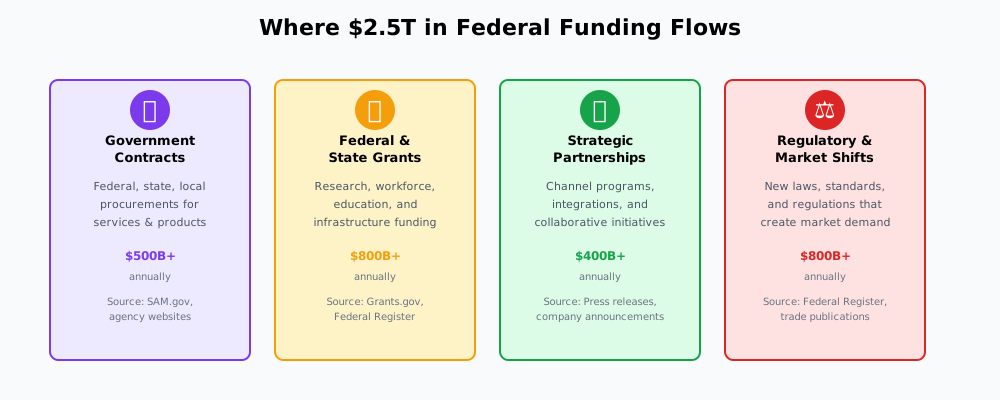
Figure 1: Capital events appear in four distinct forms. Together they represent over $2.5T in annual federal spending that organizations can compete for or benefit from.
Type 1: Government Contracts & Procurements
Federal, state, and local governments release solicitations for services, products, and solutions. These are posted on SAM.gov (federal opportunities), state procurement sites, and agency-specific platforms. A single contract can fund your organization for years.
Example: The Department of Defense releases a solicitation for AI-powered logistics optimization. The contract value is $50M over 5 years. Proposal deadline is 8 weeks away. Organizations that see this announcement in week 1 have time to research, build partnerships, and develop a strong proposal. Organizations that see it in week 6 are rushing and lose on quality.
Type 2: Federal & State Grants
Government agencies announce grant programs for specific sectors, research areas, or populations. These are typically announced on agency websites (NSF, NIH, DOE, etc.) and posted to the Federal Register. Grant deadlines usually provide 60-120 days to apply, but competitive applications require time for planning, collaboration, and proposal development.
Example: NSF announces a $50M funding program for AI education at community colleges. The deadline is 90 days away. Colleges that see this early can: identify faculty leaders, recruit partner institutions, secure letters of support, and develop detailed proposals. Colleges that start in week 7 have only 3 weeks and submit rushed applications that score lower.
Type 3: Strategic Partnerships & Channel Opportunities
Larger organizations announce partnership initiatives, integrations, or channel programs. Being selected as a partner can unlock significant revenue. But these windows are tight—partners are typically chosen within weeks of announcement through company websites, press releases, and industry announcements.
Example: A cloud infrastructure provider announces they're seeking 10 premier implementation partners in the enterprise market. Organizations have 3 weeks to apply. Those that respond immediately, present strong case studies, and demonstrate expertise are selected. Those that delay miss the cohort entirely.
Type 4: Regulatory & Market Shifts
When regulations change or new standards emerge, market conditions shift. Organizations that see these shifts first and position themselves as solutions gain competitive advantage. Regulatory shifts are announced via the Federal Register, news, and trade publications.
Example: A new data privacy law creates immediate demand for compliance consulting and infrastructure. Consulting firms that recognize this shift in month 1 and begin building service offerings capture the market. Firms that wait 6 months arrive to a crowded competitive field where pricing is lower and customers have already selected vendors.
The Visibility Gap: Why Most Organizations Miss Opportunities
The gap between organizations that capture capital events and those that miss them isn't about capability. It's about visibility. NSF research and industry analysis show that roughly 80% of eligible organizations never even see the capital events they could win.
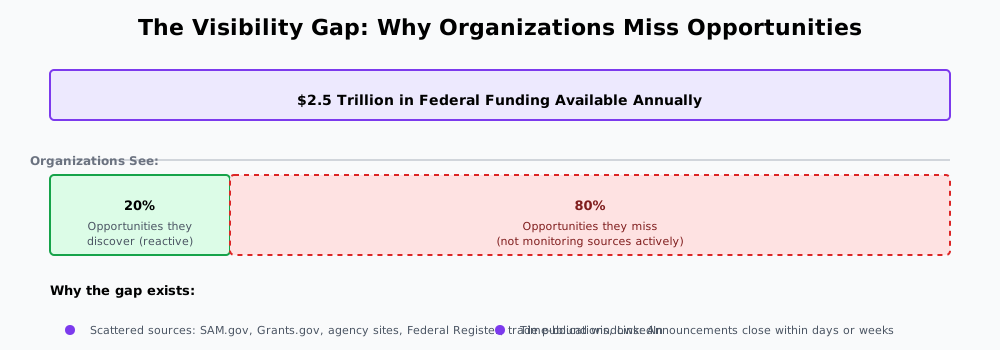
Figure 2: Most organizations miss 80% of capital events because they don't systematically monitor the sources where opportunities announce. They rely on reactive discovery instead of proactive visibility.
Problem 1: Opportunities Are Scattered Across Dozens of Sources
Government contracts appear on SAM.gov. Federal grants are on Grants.gov. Agency-specific opportunities appear on agency websites. State and local funding is scattered across dozens of state portals. Strategic partnerships are announced via press releases and company websites. Regulatory shifts are published in the Federal Register and trade publications.
A human team monitoring all these sources manually would need to spend hours daily just to stay current. Most organizations don't have that capacity. So they rely on reactive discovery—checking sources occasionally, hearing about opportunities from industry contacts, or stumbling upon announcements weeks after they're published.
Problem 2: Windows Close Quickly
Even if your team discovers an opportunity, the window to respond is narrow. Some solicitations have 30-day response windows. Some grants have 60-90 day application periods. Some partnerships have 2-3 week selection windows. Organizations that see the announcement late don't have time to build quality responses and lose to competitors who started earlier.
Problem 3: Organizations Lack a Framework for Evaluation
Without a defined framework, you can't separate high-impact opportunities from noise. You might see 100 opportunities and not realize one of them is perfect for you. Or miss the pattern that indicates an emerging capital event.
Organizations that systematically catch capital events define this in advance: "We target opportunities in X sectors, with Y deal sizes, serving Z customer types." This framework lets them instantly recognize relevant opportunities.
The Financial Impact of Capital Event Visibility
A single capital event can transform your organization's trajectory. A $2M government contract funds operations for a year. A $500K federal grant accelerates product development. A strategic partnership opens a new market.
Conservative estimate: If your organization averages 2 relevant capital events per year at $200K-$500K each:
- Capture both: $400K-$1M annually ($2M-$5M over 5 years)
- Capture one: $200K-$500K annually ($1M-$2.5M over 5 years)
- Capture neither: $0 (competitors benefit instead)
The cost of missing capital events isn't just the direct revenue. It's the competitive disadvantage that compounds: competitors gain experience, case studies, and momentum while you don't.
How Organizations Solve the Visibility Problem
Successful organizations use three approaches:
1. Digital Monitoring (Digital Employees)
Instead of assigning a human to monitor sources, they deploy digital systems that watch SAM.gov, Grants.gov, the Federal Register, and agency announcement feeds 24/7. These digital employees alert humans immediately when relevant opportunities appear, compressing the discovery window from weeks to hours.
2. Pre-Built Evaluation Frameworks
They define their targeting criteria in advance. A Capital Event Intelligence system evaluates each opportunity against these criteria automatically, surfacing only the opportunities worth human review. This eliminates the noise and lets your team focus on actually high-impact opportunities.
3. Fast Execution Systems
When a capital event qualifies, they mobilize quickly. Pre-built proposal templates, decision-making authority, and assigned proposal managers mean they can start work in days, not weeks. This turns their earlier discovery into execution advantage.
Building Your Capital Event System
Understanding capital events is the first step. Most organizations stop there and continue using reactive discovery. Organizations that scale capital event capture build sustainable systems:
- Define your opportunity profile: What sectors, deal sizes, and customer types matter for your organization?
- Set up monitoring infrastructure: Deploy digital employees to watch all relevant sources continuously
- Create evaluation processes: Build frameworks so your team can assess opportunities quickly
- Build execution readiness: Templates, decision authority, and team structure so you can mobilize fast when opportunities qualify
This is where most organizations struggle—not understanding capital events, but building sustainable systems to catch them consistently. A Capital Event Intelligence system handles the hard parts: continuous monitoring, automatic filtering, and real-time alerts. Your team focuses on strategy and execution.
Organizations that build this infrastructure in 2026 will win disproportionately—not just this year, but for years to come as they accumulate wins, case studies, and organizational capability that competitors don't have.
Ready to find your capital events?
Most organizations don't have a system to catch capital events. Start with a 5-minute assessment to see which sectors and opportunities you're positioned to win.
Find Your ClusterFree Claude Skill. Takes 5 minutes. See your personalized opportunity map.