Self-Assessment
Is Your Organization Ready for Capital Events?
Evaluate your readiness to spot and pursue capital events. Use this framework to understand where you stand and what you need to build.
The Readiness Framework
Organizational readiness for capital events has five dimensions. Each dimension has specific capabilities that determine how well your organization can spot and execute on opportunities. This assessment takes 10 minutes and reveals exactly where you should focus first.
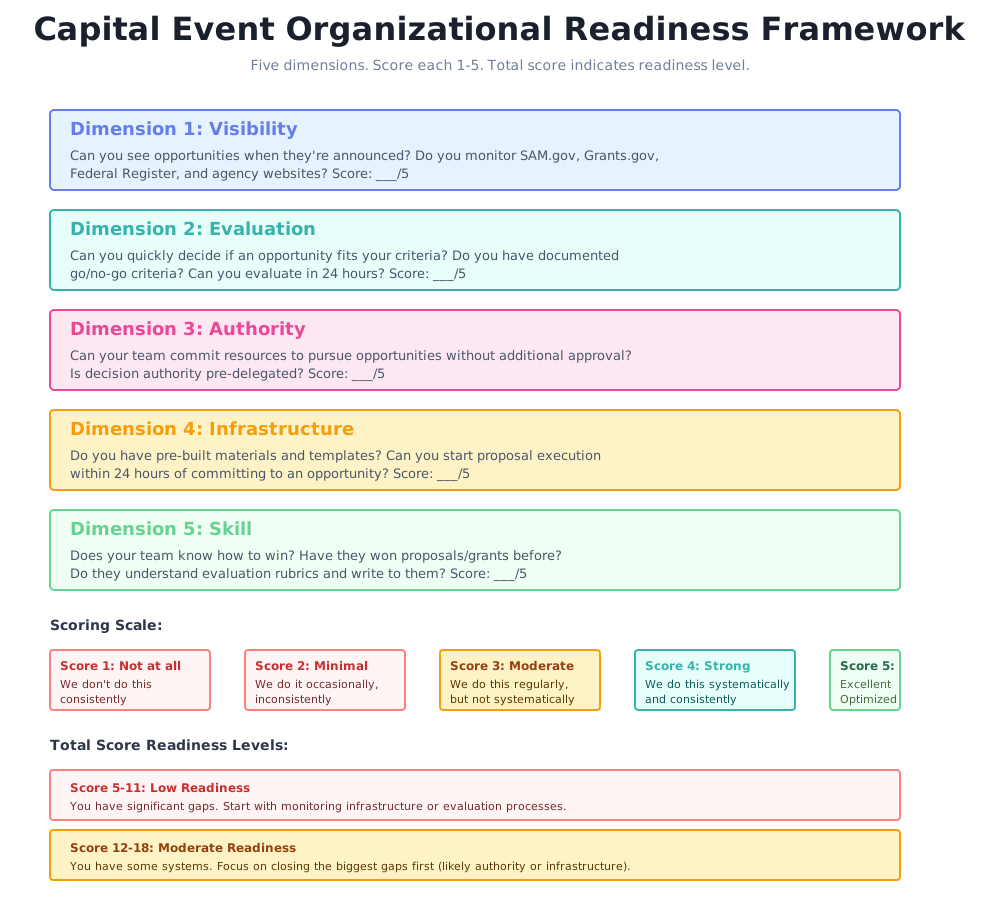
Figure 1: The readiness framework. Score each dimension 1-5. Your total score indicates which gaps will have the biggest impact on your capital event success.
As you work through this assessment, score yourself on a scale of 1-5:
- 1 = Not at all (we don't do this)
- 2 = Minimal (we do this occasionally, inconsistently)
- 3 = Moderate (we do this regularly, but not systematically)
- 4 = Strong (we do this systematically and consistently)
- 5 = Excellent (we've optimized this and continue improving)
Dimension 1: Visibility (Can You See Opportunities?)
Visibility is whether your organization sees opportunities when they're announced. This requires monitoring the sources where opportunities appear.
Key Questions
- Do you actively monitor government procurement platforms (SAM.gov)?
- Do you receive grant announcements within 1 week of publication?
- Do you monitor industry news and partnership announcements?
- Is there someone on your team responsible for monitoring, or is it ad hoc?
- Do you have documented sources where you look for opportunities?
What Good Looks Like
Score of 4-5: You have systematic monitoring. Someone on your team checks the right sources daily or weekly. Opportunities are surfaced to decision-makers within days of announcement. You know exactly where opportunities appear and you monitor those sources consistently.
Score of 1-2: You find out about opportunities ad hoc, usually weeks after they're announced. You rely on your network to tell you about things rather than monitoring sources directly.
Dimension 2: Evaluation (Can You Quickly Decide If It's Right?)
Evaluation is whether your organization can rapidly assess whether an opportunity fits your criteria and decide to pursue it.
Key Questions
- Do you have documented criteria for what makes a "good" opportunity?
- Can someone on your team evaluate a new opportunity in under 24 hours?
- Is there a clear person/process for go/no-go decisions?
- Do you pass on opportunities in under a day, or do evaluations drag on?
- Can you articulate why you pursue some opportunities and pass on others?
What Good Looks Like
Score of 4-5: You have a clear scoring framework. When an opportunity appears, it's evaluated against your criteria in 24 hours and a decision is made. You have documented reasons for go/no-go decisions.
Score of 1-2: Evaluation takes weeks. You're unsure whether opportunities qualify. Decisions are made ad hoc or require extensive committee discussion.
Dimension 3: Authority (Can You Commit Resources?)
Authority is whether the person/team that sees and evaluates opportunities has the power to commit resources to pursue them without additional approval.
Key Questions
- Can the person who sees an opportunity commit resources to pursue it?
- Or does every opportunity need to go up the approval chain?
- Is there pre-delegated authority for opportunities under $X amount?
- When a good opportunity appears, how many approval layers are there?
- Can you commit resources in days or does it take weeks?
What Good Looks Like
Score of 4-5: Authority is pre-delegated. When an opportunity qualifies, the team can commit resources without additional approvals. Authority bottlenecks don't slow you down.
Score of 1-2: Every opportunity needs to go up the approval chain. Decisions take weeks. By then, you've lost competitive timing.
Dimension 4: Infrastructure (Can You Execute Quickly?)
Infrastructure is whether you have pre-built materials, templates, and processes that let you start execution immediately when you commit to an opportunity.
Key Questions
- Do you have standard company background statements ready?
- Are your team bios and credentials documented?
- Do you have proposal templates or frameworks?
- Are budget templates available?
- Can you start writing a proposal within 24 hours of committing to an opportunity?
What Good Looks Like
Score of 4-5: You have reusable materials. When an opportunity is identified, you customize existing templates. Day 1 = customizing templates. Day 2 = drafting new sections. Day 3+ = refining and iterating.
Score of 1-2: You start from scratch. When an opportunity arrives, you spend the first 2-3 weeks assembling basic materials before you can even start drafting a proposal.
Dimension 5: Skill (Do You Know How to Win?)
Skill is whether your team has the expertise to evaluate opportunity requirements, understand what evaluators are looking for, and write compelling proposals.
Key Questions
- Does someone on your team have experience winning proposals/grants?
- Do you understand government procurement evaluation criteria?
- Can you write proposals that score well against published rubrics?
- Do you have mentorship or training on capital event strategy?
- Do you study winning proposals to understand patterns?
What Good Looks Like
Score of 4-5: You have people who have won proposals. They mentor others. Your team understands what evaluators look for. Your proposals score higher because you write to rubrics.
Score of 1-2: Proposal writing is ad hoc. You learn by losing. You don't have experienced people who can mentor others.
Scoring Your Organization
Add up your scores for each dimension:
- 20-25: You're operating at high readiness. You should be winning capital events consistently.
- 15-19: You're above average. You catch opportunities, but not all of them. You're leaving money on the table.
- 10-14: You're reactive. You catch what comes to you, but you miss most opportunities.
- 5-9: You're not ready. Most capital events pass you by unseen.
What to Do After Assessment
If You Scored 15+
You're doing many things right. Focus on your weakest dimension and build from there. Small improvements in Visibility or Evaluation can dramatically increase opportunities caught.
If You Scored 10-14
You have significant opportunities for improvement. Start with Visibility (you can't pursue opportunities you don't see). Once you're seeing opportunities consistently, work on the other dimensions.
If You Scored Below 10
You need a systematic approach. If you're score is under 12 total, you're currently reactive and missing most opportunities. Building readiness is a 3-6 month project, but the ROI is enormous. Every point you improve in Visibility, Evaluation, and Authority will directly translate to more opportunities caught and more capital captured.
What to Build First (Priority Order)
Your lowest scores indicate your biggest leaks. Here's the typical priority:
- If Visibility is low: Deploy a Capital Event Intelligence system to monitor SAM.gov, Grants.gov, and Federal Register continuously. This is your biggest bottleneck.
- If Evaluation is low: Write down your go/no-go criteria in the next week. Define sectors, deal sizes, customer types. This is one document. Use it to evaluate every opportunity immediately.
- If Authority is low: Schedule a meeting with your leadership. Pre-delegate decision authority: "If an opportunity meets these criteria, the proposal manager can commit up to $X without additional approval." Remove the approval bottleneck.
- If Infrastructure is low: Build proposal templates and material libraries. This is a 4-week project. Start this month.
- If Skill is low: Bring in external expertise or training. Have your proposal team study federal evaluation rubrics and winning proposals in your sector.
Most organizations see the biggest quick wins from improving Visibility and Evaluation. Those two improvements alone can double your capture rate within 60 days.
Get Your Detailed Readiness Assessment
Use our Capital Event Intelligence assessment to get your specific scores across all five dimensions, understand which gaps will have the biggest impact, and get personalized recommendations on what to build first.
Get Your Readiness AssessmentSee your specific scores and a prioritized action plan for closing your biggest gaps