Resource Efficiency
Manual vs Automated Monitoring: The Hidden Burden on Your Team
One person assigned to monitor federal opportunities full-time eventually burns out. Automated systems never do. Here's what that costs.
The Team Member Who Became a Monitoring System
Your organization needed someone to monitor federal opportunities. You hired Sarah. She's detail-oriented, organized, and thorough. You gave her a role: Watch SAM.gov, Grants.gov, and your state's opportunity portal. Alert the leadership team when relevant opportunities appear. Track everything in a spreadsheet.
For the first few months, it's great. Sarah checks sources every morning, reviews what's posted overnight, flags opportunities for discussion. Leadership gets alerts. Good opportunities get pursued.
But then six months in, things start to shift. Sarah is getting emails at 10 PM from an agency posting on the Federal Register. She's checking her phone on weekends because she worries she might miss something. She's got spreadsheets within spreadsheets. The work has no clear end point—opportunities post 24/7, and there's always more to monitor.
By month 10, Sarah is burned out. She's still doing the monitoring, but her attention is slipping. She misses opportunities. Her spreadsheets aren't being updated. Her enthusiasm is gone. Leadership is frustrated. Sarah is miserable.
This is the fundamental problem with manual monitoring: You're asking a human to do work that humans weren't designed for. Work that never stops. Work with no reasonable shift structure. Work that has a high error rate and causes burnout.
Why Humans Can't Sustainably Monitor 24/7
Federal opportunities don't follow a 9-to-5 schedule. They post at all hours. Grants are announced Friday evenings. Solicitations go live Saturday mornings. State agencies post at midnight. But human beings need sleep, weekends, and vacation.
There's a fundamental mismatch between the nature of federal capital events (24/7 availability) and the nature of human workers (limited attention, need for rest, tendency toward burnout).
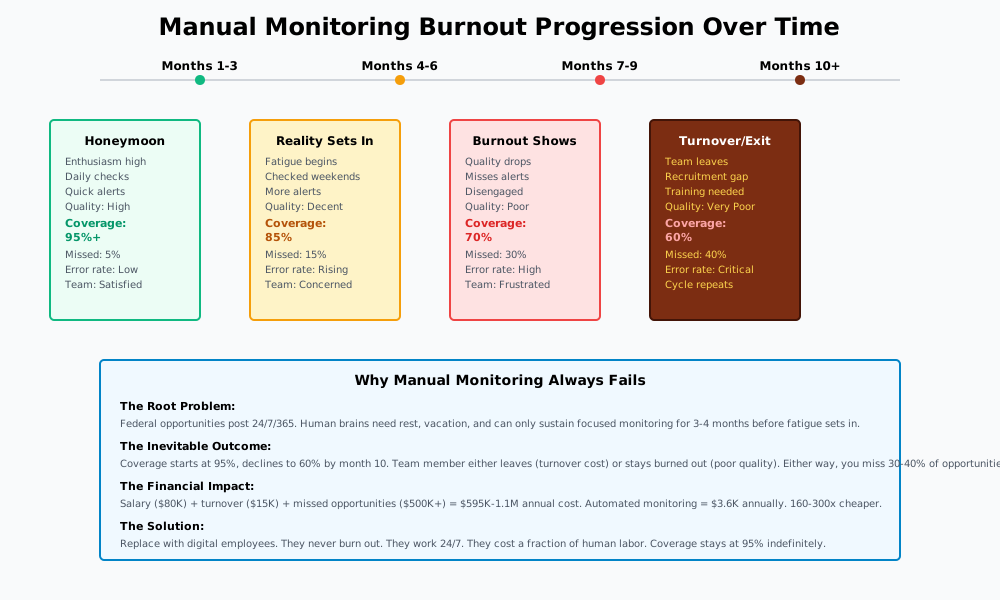
Figure 1: Manual monitoring burnout is predictable. Quality declines steadily as team member fatigue accumulates. By month 10, error rate and missed opportunities have doubled or tripled.
The Burnout Timeline: What Always Happens
Months 1-3 (Honeymoon Phase): Your team member is enthusiastic. The work is new. They're checking sources daily. They're flagging opportunities. Response time is fast. Coverage is 95%+.
Months 4-6 (Reality Sets In): The team member realizes this is permanent work with no natural end. Opportunities post on weekends and evenings, but they're not getting paid extra for weekend monitoring. They feel like they should be checking their phone constantly. The workload doesn't decrease. Coverage drops to 85%.
Months 7-9 (Fatigue Visible): Quality drops visibly. They miss opportunities. They're less enthusiastic in meetings. They start saying things like "I'm not sure I'm cut out for this." They take more sick days. Their spreadsheets get less organized. Coverage down to 70%.
Months 10+ (Turnover or Resentment): Either they quit and you're hiring someone new (starting the cycle over), or they stay but mentally check out. Either way, coverage drops to 60% and quality has degraded significantly. You're missing 40%+ of opportunities.
The True Cost of Manual Monitoring
Most organizations don't measure the true cost of manual monitoring. They think: "We assigned Sarah to do this. Her salary is sunk. It's free." But it's not. The real cost includes five major components:
1. Salary Cost Dedicated to Low-Leverage Work
You're paying someone $70-100K+ annually to watch websites and fill spreadsheets. That's salary that could go to business development, strategy, or proposal quality. You're dedicating significant FTE capacity to work that digital employees could do for $300/month. Annual cost: $70-100K in salary + benefits.
2. Quality Degradation from Burnout
The team member starts missing opportunities as fatigue accumulates. By month 8-10, your discovery rate drops from 95% to 60-70%. You're missing opportunities you should be seeing. Cost: 15-30% of available opportunities missed (several million dollars in undetected capital events annually).
3. Turnover and Replacement
When your monitoring person burns out and leaves, you lose 2-4 months to recruitment and onboarding. The new person doesn't know your systems, targets, or priorities. You lose continuity in opportunity tracking. Cost: $10-20K in recruitment + 3-4 months of reduced monitoring quality.
4. Opportunity Cost of Their Time
The person you assigned to monitoring could be doing strategy work, relationship building, or business development. Instead, they're watching websites. That's high-potential work not being done. Cost: 50-100% of their potential contribution to revenue-generating activities.

Figure 2: True cost of manual monitoring includes salary, turnover, and missed opportunities. Automated monitoring is 100-300x cheaper annually and catches more opportunities.
How Automated Systems Handle The Load
Digital employees never sleep. They don't get tired. They don't get resentful about evening postings. They don't burn out. And they work at a cost that's a fraction of human labor.
Here's what automated monitoring systems do:
- 24/7/365 coverage: Monitor continuously without breaks, vacation, or sick days
- Consistent quality: Same detection accuracy regardless of fatigue, mood, or time of day
- No turnover: Once deployed, the system keeps working indefinitely with zero replacement risk
- Automatic filtering: Process hundreds of opportunities and flag only relevant ones automatically
- Immediate alerts: Send notifications within minutes of discovery, not hours or days later
- Perfect record keeping: Every opportunity logged, tracked, and searchable
The Team Morale Impact
There's also a team dynamics cost to manual monitoring that most organizations overlook. When one person is assigned to monitoring, they often feel:
- Isolated: Monitoring is solo work, not team-based
- Unvalued: It's seen as administrative work, not strategic
- Stuck: They can't advance because they're essential to the monitoring function
- Resentful: They're working 24/7 mentally while colleagues have bounded work
- Anxious: They worry constantly about missing something important
This affects team culture and retention. Your best people leave because the monitoring role is a dead-end assignment. Less engaged people end up in the role and don't perform as well.
Five Reasons To Shift From Manual To Automated
The business case for automation is clear:
1. Cost Efficiency
Automation costs $3-5K annually. Manual monitoring costs $70-100K+ in salary plus recruitment and turnover. That's a 20-30x difference in direct costs, and the gap widens when you account for missed opportunities.
2. Coverage Completeness
Digital employees catch 95%+ of opportunities. Manual monitoring catches 60-70% initially and declines over time. You're leaving $500M+ on the table by staying manual.
3. Time Freed for High-Value Work
The person freed from monitoring can focus on business development, relationships, and strategy. That's where your growth lever actually is—relationship-building and proposal quality, not spreadsheet maintenance.
4. Consistency and Reliability
No burnout. No vacation gaps. No sick days. No team member leaving and losing continuity. Pure reliability. The system works the same way every day, every week, every year.
5. Improved Win Rates
Earlier discovery + more opportunities found = more proposals developed with adequate time. Win rates increase from 8% to 18%+. That directly translates to capital captured.
The Transition Path: From Manual to Automated
If you currently have someone doing manual monitoring, the transition is straightforward:
- Week 1-2: Deploy automated monitoring system alongside manual monitoring. Run in parallel so you can compare coverage.
- Week 3: Audit: Does the system catch the same opportunities your team member catches? Are there gaps? Refine filters.
- Week 4: Transition the team member to other work. They help refine the system, then move to business development, relationships, or strategy.
- Ongoing: The system handles monitoring. The person handles higher-value work. Everyone is happier.
What To Do With The Freed Capacity
When you shift from manual to automated monitoring, you free up significant FTE. Don't waste it on other administrative work. Use it for:
- Business development: Building relationships with decision-makers and agencies
- Proposal strategy: Developing winning proposal approaches instead of rushing proposals
- Customer research: Understanding government needs deeply instead of just reacting to solicitations
- Sector expansion: Exploring new sectors and adjacent opportunities
- Partnership development: Building teaming and subcontracting relationships
The freed time generates more revenue than the salary cost. You've essentially freed up high-leverage work that actually drives federal capital capture.
The Decision: Burnout or Automation
If you're currently using manual monitoring, you're paying one of these costs:
- Your team member is burned out and quality is declining
- You're spending $70K+ annually on work that could be automated for $3.6K
- You're missing 20-40% of opportunities because human monitoring has gaps
- You're losing access to high-value work because someone is stuck in monitoring
Shift to automation. Deploy digital employees to handle 24/7 monitoring. Free up your team for work that actually drives federal capital capture. This move costs almost nothing and returns millions in captured opportunities.
Shift From Manual to Automated Monitoring
Free your team from 24/7 monitoring burnout. Deploy digital employees that catch more opportunities, cost less, and never burn out.
Explore Capital Event IntelligenceAutomated monitoring with zero burnout. Catches 95%+ of opportunities. Costs less than one team member's salary.