Competitive Assessment
Evaluate Your Capital Event Position: How Do You Actually Rank?
Your organization thinks you're competitive. Your data says otherwise. Here's how to measure your actual position honestly.
The Honest Competitive Reckoning
Your leadership team meets monthly to discuss federal opportunities. Someone nominates a solicitation. The room goes quiet. "Well, we *could* pursue it," someone says. "Our capabilities are pretty close to what they're asking for." Nobody argues. A proposal starts.
Six weeks later, you lose. The winner had deeper experience in that sector. More federal delivery history. Better relationships with the agency. A stronger team. When you read the award decision, the gap is obvious. You weren't really competitive. You both knew it when you started the proposal, but you pursue anyway because you hope.
This happens because most organizations don't honestly evaluate their competitive position. They have a vague sense of "we're pretty good" without measuring exactly where they stand versus competitors. Digital employees make data-driven assessment possible.
The Five Dimensions of Competitive Position
Competitive position in capital events has five measurable dimensions. When evaluated honestly, they show you exactly where you're strong and where you're weak:
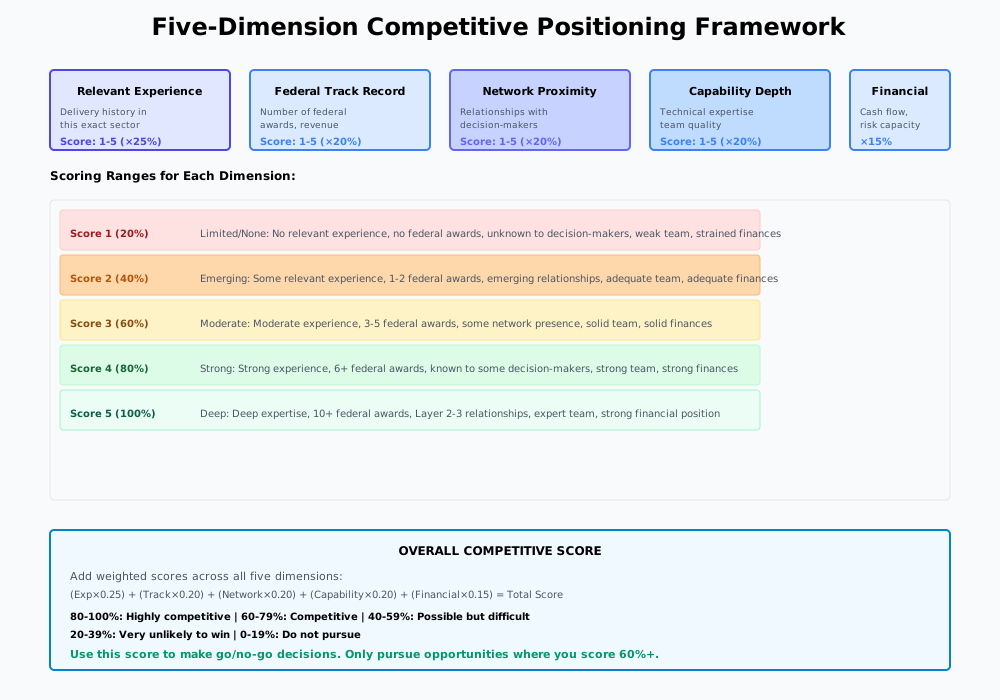
Figure 1: Five dimensions determine competitive position. Score each honestly to reveal what needs improvement.
Dimension 1: Relevant Experience (Weight: 25%)
How much experience do you have delivering exactly what this solicitation is asking for? Not similar work—actual relevant work in this specific problem space.
Scoring: 1-5 (1=None, 3=Moderate experience, 5=Deep expertise in this exact space). Multiply by 25% weight.
Dimension 2: Federal Track Record (Weight: 20%)
How many federal contracts have you won in this sector? How much federal revenue have you delivered? Agencies want contractors with proven federal delivery experience.
Scoring: 1-5 (1=No federal history, 3=Some federal contracts, 5=Strong federal portfolio). Multiply by 20% weight.
Dimension 3: Network Proximity (Weight: 20%)
Do decision-makers in this space know you? Would they think of you when designing a solicitation? Or would they have to discover you through the public announcement?
Scoring: 1-5 (1=Layer 5-6, unknown, 3=Layer 4, some awareness, 5=Layer 2-3, known to decision-makers). Multiply by 20% weight.
Dimension 4: Capability Depth (Weight: 20%)
Do you have the technical expertise and team depth to deliver at the scale required? Can you attract top talent? Do you have depth or would you be stretched thin?
Scoring: 1-5 (1=Shallow team, would struggle, 3=Adequate but stretched, 5=Deep expert team). Multiply by 20% weight.
Dimension 5: Financial Strength (Weight: 15%)
Can you finance this contract? Do you have cash to absorb cost overruns? Can you deliver if the federal government pays you in arrears? Or would you be strapped from day one?
Scoring: 1-5 (1=Weak, would struggle, 3=Adequate, 5=Strong financial position). Multiply by 15% weight.
Calculating Your Competitive Score
Score each of the five dimensions 1-5. Multiply by the weight. Add them up. This gives your overall competitive position score (0-500 scale, or 0-100% scale).
Scoring Guide:
- 80-100%: Highly competitive. You should pursue this opportunity aggressively.
- 60-79%: Competitive. You have a reasonable shot if you execute well.
- 40-59%: Possible but uphill. You'd need flawless execution and luck.
- 20-39%: Very unlikely to win. Pursue only if strategic value beyond this single win.
- 0-19%: Don't waste proposal resources. Pass.
Using Honest Positioning to Make Go/No-Go Decisions
Most organizations pursue opportunities they're not competitive for because they lack a systematic way to say "no." Implementing this five-dimension assessment creates a data-driven decision framework.
Now when a solicitation is nominated, you can ask:
- "What's our honest competitive score on this?"
- "Are we above 60%?"
- "If we're below 60%, what would we need to change to get there?"
- "Is this worth pursuing given our actual position, or should we pass and save resources for opportunities where we're truly strong?"

Figure 2: Use the scoring ladder to make go/no-go decisions systematically. This prevents wasting proposal resources on low-probability opportunities.
What Makes a Digital Employee Assessment Accurate
Humans naturally bias toward optimism when assessing their own position. Digital employees enable objective scoring by analyzing:
- Historical win/loss data: How often do organizations with your profile win against competitors with their profile?
- Sector benchmark data: What do winning organizations in this sector look like?
- Federal award data: How many awards does your organization have versus known competitors?
- Federal Register analysis: What language appears in solicitations you win vs solicitations you lose?
- Solicitation requirement matching: How deeply do your capabilities actually align with published requirements?
Improving Your Positioning Over Time
If you score 55% on this solicitation, you know exactly what would improve your position:
- Weak on Relevant Experience? Take on similar work now to build that dimension for future opportunities.
- Weak on Federal Track Record? Pursue smaller federal contracts to build that portfolio.
- Weak on Network Proximity? Invest in relationships, advisory boards, speaking (18-24 month play).
- Weak on Capability Depth? Hire experts, build partnerships, conduct training.
- Weak on Financial Strength? Strengthen balance sheet or secure bonding/financing.
Each dimension has a specific improvement strategy. When you know which dimensions are weak, you can target improvements deliberately instead of hoping.
The Organization That Wins Capital Events
Organizations that win federal capital consistently do three things differently:
- Honest assessment: They score their competitive position accurately, not optimistically.
- Selective pursuit: They only pursue opportunities where they score 60%+ competitively.
- Continuous improvement: They use weak dimension scores to guide strategic investments in capability building.
Organizations that lose consistently do the opposite: pursue everything, hope for wins, wonder why they lose so much. Start measuring your actual position and making data-driven decisions instead.
Assess Your Competitive Position
Get honest about where you actually rank versus competitors. Use our five-dimension framework to score your position and make better go/no-go decisions.
Run Your AssessmentFree Claude Skill. Get your five-dimension score and understand what to improve.