Build vs. Buy
DIY vs. Outsource Capital Event Monitoring
Should you build a monitoring system internally or use a service? Here's how to decide based on your budget, team, and timeline.
The $300K Decision: The Real Cost of Building vs. Buying
Your VP of Operations brings you three options. "We need to monitor capital events systematically," she says. "Option 1: We assign someone part-time to watch SAM.gov, Grants.gov, and agency websites. Cost: about $20K in salary and tools annually. Option 2: We hire a specialized person for this full-time. Cost: about $70K annually plus tools. Option 3: We subscribe to a service that does it for us. Cost: about $40K annually."
On the surface, Option 1 looks like the winner. But here's what happens next: It takes 8-12 weeks to build a functional system. In those three months, you miss opportunities your service-using competitors catch. When the person you assigned gets promoted, you lose continuity. When sources change their formats (which happens quarterly), your system breaks temporarily. When you need to expand monitoring to a new sector, you're redesigning the whole system.
By year end, when you factor in missed opportunities, staff turnover costs, and system downtime, Option 1 cost you roughly $250K in lost competitive advantage. Option 3 would have saved you money. This choice—build vs. buy—is one of the most misunderstood decisions in capital event strategy.
The DIY Approach: Build It Yourself
How It Works
You assign an employee (or a small team) to set up monitoring infrastructure. They:
- Identify the sources where opportunities appear (SAM.gov, agency websites, Grants.gov, etc.)
- Set up alerts/RSS feeds/email subscriptions from those sources
- Create a process to evaluate opportunities against your fit criteria
- Maintain and update the system over time as sources change
What It Costs
Time investment: 40-60 hours initially to set up. Then 3-5 hours per week ongoing maintenance.
Labor cost: If you assign one person part-time to this, that's roughly $15K-$25K per year in salary + benefits (at ~$50K annual salary, pro-rated for 10% of their time).
Tool costs: Some sources are free (SAM.gov, agency websites). Others have subscription costs:
- Grant research tools: $100-$300/month
- News/industry monitoring: $50-$200/month
- Custom alert systems: $0-$200/month
- Total annual tool costs: $2K-$7K
Total DIY cost: $17K-$32K per year (plus whatever you build internally, which has hidden costs in staff time, opportunity cost, etc.)
Advantages of DIY
- Full control. You build exactly what you need. No compromises.
- Custom fit. The system reflects your exact criteria and processes.
- No vendor lock-in. You own the infrastructure and can modify it anytime.
- Lower marginal cost. After initial setup, additional users cost almost nothing.
Disadvantages of DIY
- Slow to launch. Takes 2-3 months to build and test before you're seeing results.
- Requires expertise. You need someone who understands grant databases, government procurement, and your industry.
- Maintenance burden. When sources change or systems break, your team fixes it.
- Limited intelligence. You monitor sources, but you don't get curated analysis or strategic insights.
- Scaling challenges. As you expand to new sectors or geographies, you're adding complexity to a system you built.
The Outsource Approach: Use a Service
How It Works
You subscribe to a capital event monitoring service. They:
- Monitor sources continuously on your behalf
- Apply your criteria to filter and prioritize opportunities
- Deliver curated briefings, alerts, or a platform where you can see opportunities
- Maintain and update the infrastructure
- Provide analysis, scoring, and strategic insights
What It Costs
Service costs vary widely based on what you get:
- Basic monitoring (alerts + briefings): $500-$2,000/month
- Mid-tier (monitoring + platform + analysis): $2,000-$5,000/month
- Enterprise (custom monitoring + dedicated support + strategic insights): $5,000-$15,000+/month
Total outsource cost: $6K-$180K per year depending on the service level you choose.
Advantages of Outsource
- Fast to launch. You're seeing results in weeks, not months.
- No internal expertise required. The service provider has the expertise; you just use the results.
- Curated intelligence. You get analysis, scoring, and strategic insights, not just raw data.
- Scales automatically. Adding new sectors or geographies doesn't add complexity to your organization.
- Maintenance-free. The service provider handles all infrastructure, updates, and maintenance.
- Access to expertise. You benefit from the service provider's deep knowledge of opportunities, trends, and strategy.
Disadvantages of Outsource
- Higher cost. Service is more expensive than DIY in most cases.
- Limited control. You use what they provide; you can't customize deeply.
- Vendor dependency. If the service changes or shuts down, you lose the monitoring capability.
- Generic criteria. The service applies general filtering criteria; it may miss nuances specific to your organization.
The Real Comparison: Total Cost of Ownership
Here's where it gets interesting. The DIY approach seems cheaper ($17K-$32K/year), but that calculation misses hidden costs:
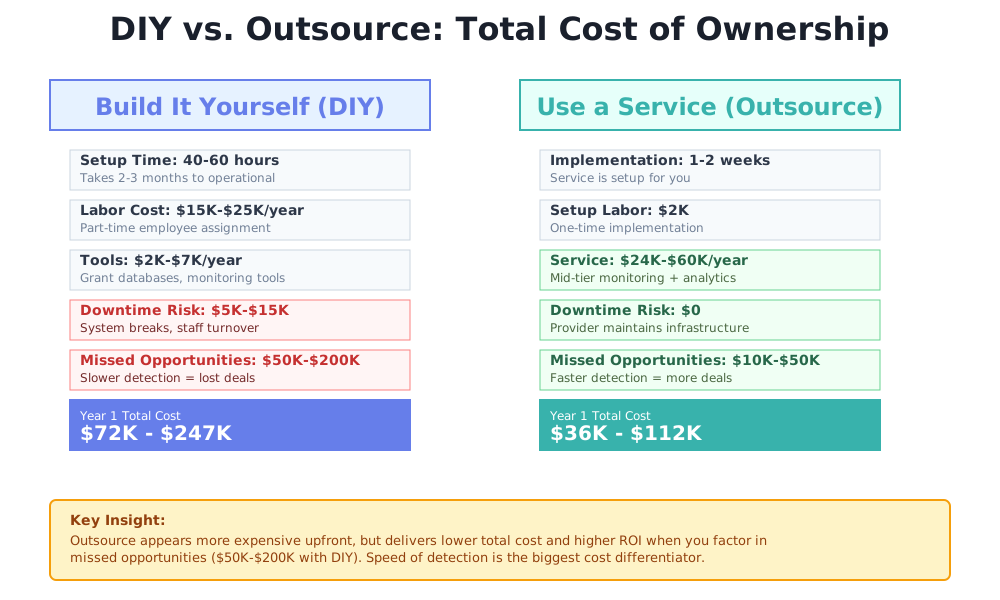
Figure 1: Total cost comparison reveals outsource delivers lower year-1 costs when accounting for missed opportunities and downtime risks inherent in DIY approaches.
| Cost Category | DIY | Outsource (Mid-Tier) |
|---|---|---|
| Labor (setup + ongoing) | $15K-$25K | $2K (implementation) |
| Tools/Software | $2K-$7K | $24K-$60K |
| Opportunity cost (issues/downtime) | $5K-$15K | $0 |
| Lost opportunities (slower detection) | $50K-$200K | $10K-$50K |
| Total Year 1 | $72K-$247K | $36K-$112K |
The outsource approach often delivers better ROI in Year 1 because it detects opportunities faster, reducing the "detection delay" cost.
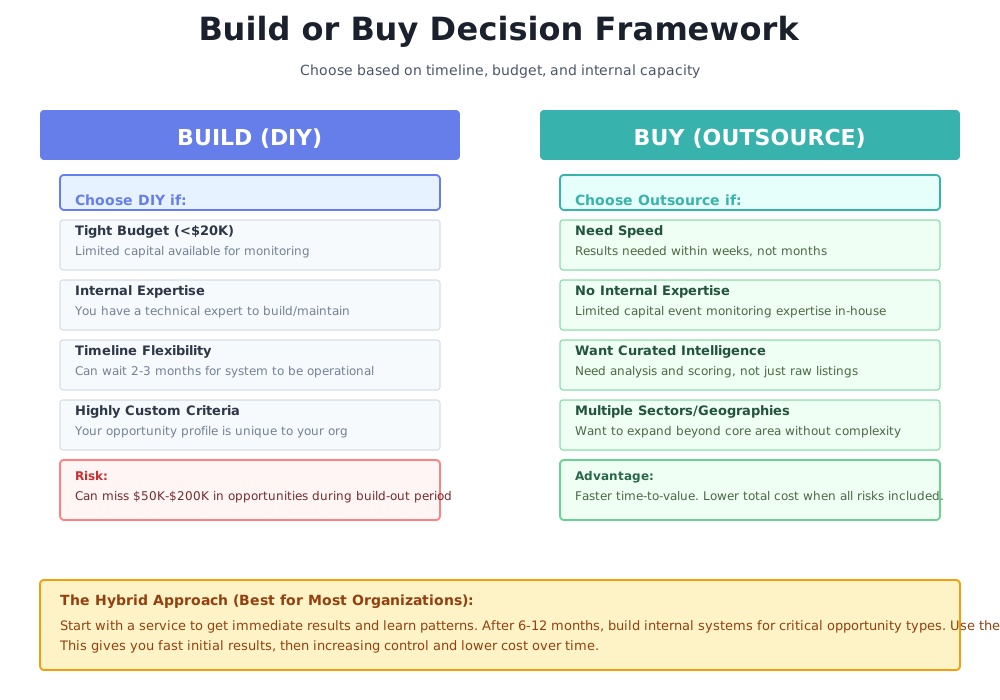
Figure 2: Use this framework to determine whether DIY or outsource aligns with your organizational constraints and opportunities.
How to Decide: The Decision Framework
Choose DIY if:
- You have tight budget constraints (less than $20K for this initiative)
- You have an internal expert who can build and maintain the system
- You have 2-3 months to get the system operational before urgency hits
- Your opportunity criteria are highly specific and unique to your organization
- You want maximum control and customization
Choose Outsource if:
- You need results within weeks, not months (2026 capital availability window is closing)
- You don't have internal expertise in capital event monitoring
- You want curated intelligence and strategic insights, not just raw opportunity listings
- You operate across multiple sectors or geographies
- You want to focus on execution and strategy, not infrastructure maintenance
- The cost of missing opportunities (in your business) is higher than the service cost
The Hybrid Approach: The Best Strategy for Most Organizations
Many of the most successful organizations don't choose pure DIY or pure outsource. They do both, strategically:
- Months 1-3 (Outsource): Subscribe to a Capital Event Intelligence service to get immediate results and learn patterns of what matters for your organization
- Months 4-12 (Build): Based on patterns learned, build internal systems for your most critical opportunity types (government contracts, specific grant categories, etc.)
- Ongoing (Hybrid): Use the service for secondary opportunities and specialized sectors while managing core monitoring internally
- Year 2+ (Control): Gradually migrate toward more DIY with the service handling edge cases and specialized sectors
This approach gives you the best of both: fast initial results when capital availability is highest, then increasing internal control and lower cost over time. You avoid the "slow ramp-up" risk of pure DIY while avoiding the long-term vendor lock-in risk of pure outsource.
What to Evaluate in a Service
If you're leaning toward outsourcing, here's what to look for in a Capital Event Intelligence platform:
- Coverage: Does it monitor SAM.gov, Grants.gov, agency websites, and other sources where your opportunities appear?
- Filtering: Can you customize criteria to reduce noise and focus on what matters for your sectors and deal sizes?
- Speed: How fast do opportunities get to you after they're announced on Federal Register or government platforms?
- Intelligence: Does it just list opportunities, or does it score and analyze them for fit and quality?
- Integration: Does it work with your existing tools and workflows?
- Support: Do you get human support or just a platform?
- Flexibility: Can you scale it as your needs change and expand to new sectors?
The Digital Employee Advantage
Whether you build or buy, the core advantage is the same: replacing human monitoring work with digital systems. A good Capital Event Intelligence system is a digital employee that:
- Never sleeps: Monitors sources 24/7 while your team focuses on execution
- Never forgets: Catches opportunities the day they're announced, not weeks later
- Never makes excuses: System doesn't take vacation or get promoted to another department
- Gets smarter: As you customize criteria and provide feedback, the system learns what matters for your organization
The build vs. buy decision isn't about the tool. It's about whether you have the capacity and expertise to build and maintain a digital employee, or whether you should outsource that work to a team that specializes in it.
The Bottom Line
Most organizations should outsource in 2026. Here's why: You don't have time to build and test. The window for federal capital is open now and will begin closing in 12-18 months. Organizations that have monitoring systems running today will capture capital that organizations starting to build in July won't even see.
The cost of outsourcing is real, but it's cheaper than the cost of building slowly, maintaining internally while your expert gets promoted, and missing $100K-$300K in opportunities while you optimize your DIY system. Choose a service, get it running in weeks, and start capturing capital events while your competitors are still in project planning mode.
Ready to Set Up Monitoring?
Whether you decide to build or buy, the goal is the same: systematic discovery of capital events. Start with our Capital Event Intelligence assessment to see what you're currently missing.
Explore Capital Event IntelligenceSee which opportunities you're currently missing and learn whether outsource or hybrid approach is right for your organization.