Infrastructure
Building Your Internal Proposal System
Templates, processes, and trained people. This is what separates organizations that win capital events from those that miss them.
Why Proposal Systems Matter
Here's what separates organizations that catch capital events from those that don't: when an opportunity arrives, organizations with proposal systems can start executing immediately. Organizations without them spend weeks getting oriented before they begin writing.
A good proposal system compresses weeks of setup time into hours. That compression is your competitive advantage. It's the difference between submitting a first-draft proposal in week 8 and submitting a refined, iterated proposal in week 7. That one week of extra iteration usually determines who wins.
The Three Components of a Proposal System
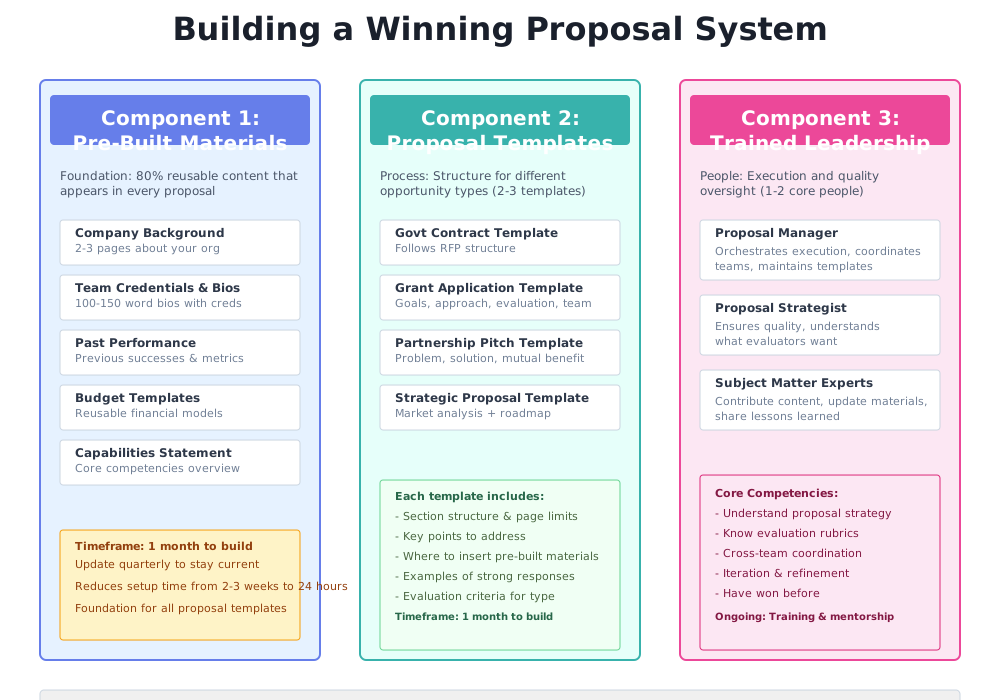
Figure 1: A complete proposal system has three integrated components: reusable materials, templates, and trained people. Together they compress proposal creation time and improve quality through iteration.
1. Pre-Built Materials (The Foundation)
Pre-built materials are standard content that applies to most opportunities. They're 80% generic and 20% customizable. These materials should exist before any opportunity arrives.
Company Background Statement
A 2-3 page overview of your company: history, mission, capabilities, market position, notable clients/projects. This appears in almost every proposal. You write it once, customize it slightly for each opportunity.
Team Credentials & Bios
Short bios (100-150 words each) for key team members. Include credentials, experience, past projects, why they're relevant to capital events. Keep these up to date. When an opportunity needs 3 subject matter experts, you pull from this pre-built library.
Past Performance Documentation
Summaries of previous successful projects, grants won, or initiatives completed. Government opportunities often require this. Having it documented in advance (with metrics, outcomes, impact) saves weeks of scrambling.
Budget Templates
Standard budget formats for your organization. Different opportunities require different budget structures, but having standard templates lets you customize, not rebuild, the financial model.
Organizational Capabilities Statement
What can your organization do? What are your core competencies? How do you deliver? This is boilerplate that appears in most proposals. Write it once, customize for each opportunity type.
2. Proposal Templates (The Process)
Proposal templates give you a structure for responding to common opportunity types. You're not building from scratch; you're customizing existing frameworks.
Create templates for:
- Government contract proposals (usually follow the RFP structure)
- Grant applications (standard sections: goals, approach, evaluation, team, budget)
- Partnership pitches (problem, solution, mutual benefit, implementation)
- Strategic proposals (market analysis, capability fit, implementation roadmap)
Each template should include:
- Section structure and page allocation
- Key points that should be addressed
- Places where you insert pre-built materials
- Examples of strong responses
- Common evaluation criteria for that opportunity type
With these templates, when a new opportunity arrives, a proposal manager can set up the document framework and know exactly what needs to be written, where, and why.
3. Trained Proposal Leadership (The People)
Materials and templates don't execute themselves. You need people who:
- Understand proposal strategy: They know what evaluators are looking for. They write proposals to rubrics, not to their own preferences.
- Can coordinate across teams: Proposals pull from multiple departments. The proposal leader brings it all together.
- Can iterate and refine: They know how to review drafts, identify weak sections, and guide rewrites.
- Have won before: They've submitted proposals and seen what works and what doesn't.
For most organizations, this is 1-2 people: a proposal manager (who orchestrates) and a proposal strategist (who ensures quality).
Building Your System: The Timeline
Month 1: Assessment & Planning
Identify what proposal types are most common for your organization. Do you mostly pursue government contracts? Grants? Partnerships? Focus your templates on the opportunity types that will drive 80% of your capital.
Month 2: Build Pre-Built Materials
Create the foundational materials: company background statement, team bios, past performance documentation, budget templates, capabilities statement. These should be complete and current before you build templates.
Month 3: Build Templates
Create 2-3 proposal templates based on your most common opportunity types. Each template includes structure, section guidance, and examples.
Month 4: Test & Train
Use your templates on a real opportunity. Find gaps and refine. Train your proposal team on how to use the system. Document the process.
Ongoing: Maintain & Improve
After every proposal, update your materials and templates based on what you learned. What worked? What should we change? Keep the system evolving.
Who Should Own This?
Building the system requires different people:
- Executive sponsor: Ensures resources and commitment. Removes obstacles.
- Proposal manager: Builds and maintains templates and materials. Coordinates proposals.
- Subject matter experts: Contribute content and strategies. Update materials based on what's working.
- Proposal writers: Execute against templates. Provide feedback on what's missing or unclear.
The ROI
Building a proposal system costs time and resources upfront (4 months, 1 person, maybe some external expertise). The return is enormous:
- Faster execution: Proposals that would take 8 weeks now take 5 weeks. That extra 3 weeks of iteration improves quality.
- Higher win rates: Better-written, more-refined proposals win more often. You might increase win rates from 20% to 35%.
- More proposals per year: With a process, you can pursue more opportunities. You're not burned out from custom-building every proposal.
- Talent development: Your team learns proposal strategy. You build capability that compounds.
If one additional $1M contract win per year is the result, and you spent $30K-$50K building the system, the ROI is 20-33x in the first year alone.
Common Mistakes to Avoid
Building templates before you have materials
Templates without pre-built materials still require custom content for every proposal. Build materials first, then templates that slot them in.
Building too many templates
You don't need templates for every scenario. Focus on the 2-3 opportunity types that drive 80% of your capital. Build those well, then expand.
Not updating materials
Your company background statement and team bios get stale. Set a quarterly review process to ensure materials are current.
Treating templates as constraints
Templates are frameworks, not straightjackets. Customize them for each opportunity. The goal is speed, not rigid adherence.
Getting Started Today
You don't need to build everything at once. Start with one proposal type:
- Look at your last 3 successful proposals (government, grants, or partnerships)
- Extract common sections and content across them
- Create a template based on that pattern
- Use it on your next proposal when a capital event qualifies
- Refine based on what you learn during execution
Start small. Build from there. In 3-4 months, you'll have infrastructure that would have taken weeks to create if you'd approached it strategically from the start. Combine this with a Capital Event Intelligence system to monitor opportunities, and you're positioned to capture capital events that competitors won't even see until it's too late.
The Multiplier Effect
A good proposal system doesn't just help you win more. It compounds: You attract better talent because proposal execution becomes systematic and manageable. Your team develops expertise because they're not starting from scratch every time. Your win rate increases because proposals get more iteration and refinement. Over time, organizational capability becomes your competitive advantage. Organizations that build proposal systems now, combined with systematic capital event discovery, will dominate their markets for the next 5 years.
Ready to Build Your Proposal System?
Start by understanding which capital events you should be pursuing. Our Capital Event Intelligence assessment shows you which opportunities fit your organization and what your team needs to execute. Then build your proposal system to win them.
Explore Capital Event IntelligenceDiscover your opportunity landscape and see which capital events you're currently missing