Market Blindspots
The Blindspot Audit: Finding Capital Events You're Completely Missing
Right now, $2.5 trillion is flowing into 7 federal infrastructure sectors. Some of that capital is available to your organization. Some of it is invisible to you.
The $500M Opportunity You Didn't Know Existed
Your organization is a workforce development nonprofit. You've spent 10 years building expertise in job training for manufacturing sectors. You're good at it. You've helped 5,000+ people get jobs. You've built a strong reputation with manufacturers and community colleges.
But you have a blindspot.
Right now, the federal government is deploying $50B+ in AI infrastructure funding. They're building data labeling centers, AI training hubs, and model development facilities. And they need an army of people trained to work in these facilities. This is a federal capital deployment you've never noticed because you don't monitor AI sectors. You monitor manufacturing. They're adjacent but separate in your mind.
Meanwhile, a competitor in the AI space sees this funding. They adjust their training offerings slightly. They win a $25M federal grant to train 2,000 people for AI infrastructure roles. They repeat this for four years. $100M in total revenue from this single capital deployment.
Your organization could have done this. You had the infrastructure. You had the expertise in workforce training. You just didn't see the opportunity because it was outside your sector blindspot. And $100M is what blindspots cost.
Understanding Blindspots: The Capital You Can't See
Your organization has a natural focus. You operate in a sector. You serve a customer type. You've built deep expertise. This focus is good—it creates competitive advantage. But it also creates a blindspot: capital flowing in sectors you don't monitor.
The federal government is spending $2.5 trillion on infrastructure, innovation, and capability development. Some of that capital is available to your organization. And some of it is completely invisible to you because it's outside your sector focus.
The Pattern: When Capital Flows Into Your Adjacent Sectors
Capital events follow a predictable pattern. They happen in markets where three conditions are simultaneously true:
- Large capital investment: The federal government is deploying billions on a specific problem or sector.
- Workforce shortage: There aren't enough qualified people to do the work at the scale needed.
- Manual processes: The work is still being done manually instead of being automated or optimized.
When all three are true simultaneously, capital flows. And wherever capital flows, opportunities emerge for organizations that can solve the bottlenecks—if they can see them.
The 7 Active Capital Deployment Sectors (2026)
Federal capital is currently flowing into 7 major infrastructure sectors totaling $2.5 trillion+. For each sector, all three conditions are true: massive capital deployment, workforce shortage, and manual processes creating bottlenecks.
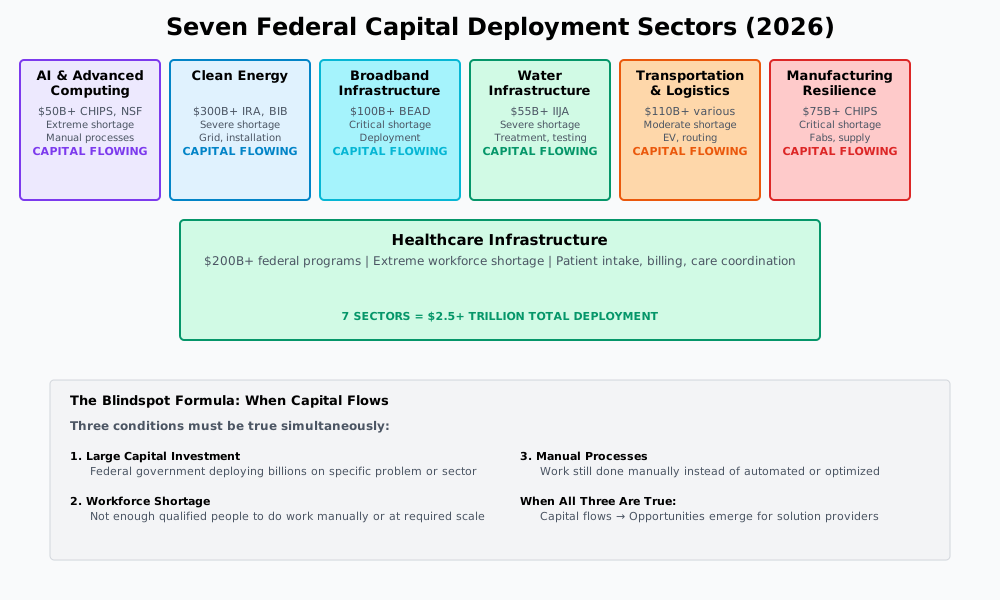
Figure 1: $2.5 trillion is currently flowing into seven federal infrastructure sectors. Each has massive capital deployment, critical workforce shortage, and manual processes that create opportunity for solution providers.
1. AI & Advanced Computing
Semiconductor fabrication, AI training infrastructure, quantum computing, advanced processors. Federal spending: $50B+ (CHIPS Act, NSF, DoD). Workforce shortage: Extreme. Manual processes: Data labeling, model training, infrastructure deployment.
Blindspot question: Are you positioned to serve the AI infrastructure build-out? Or are you only looking at AI applications?
2. Clean Energy
Solar, wind, grid modernization, battery storage. Federal spending: $300B+ (IRA, Bipartisan Infrastructure Bill). Workforce shortage: Severe. Manual processes: Installation, grid management, supply chain.
Blindspot question: If you're in energy, are you following the renewable transition? Or are you still focused on legacy systems?
3. Broadband Infrastructure
Last-mile connectivity, fiber deployment, rural internet. Federal spending: $100B+ (Broadband Equity, Access & Deployment). Workforce shortage: Critical. Manual processes: Deployment planning, installation, maintenance.
Blindspot question: Are you positioned for broadband deployment? Most tech companies think broadband is "someone else's" problem.
4. Water Infrastructure
Treatment facilities, pipe replacement, contamination remediation. Federal spending: $55B+ (Infrastructure Investment and Jobs Act). Workforce shortage: Severe. Manual processes: Testing, treatment, maintenance.
Blindspot question: If you're in environmental services, are you following water infrastructure funding? Or only traditional environmental consulting?
5. Transportation & Logistics
EV infrastructure, autonomous vehicles, supply chain optimization. Federal spending: $110B+ (various programs). Workforce shortage: Moderate. Manual processes: Vehicle routing, driver management, fleet optimization.
Blindspot question: Are you positioned for EV adoption? Or are you still serving gas-engine supply chains?
6. Manufacturing Resilience
Semiconductor fabs, rare earth processing, medical device production. Federal spending: $75B+ (CHIPS, Defense Production Act). Workforce shortage: Critical. Manual processes: Production planning, quality control, supply chain.
Blindspot question: If you're in manufacturing, are you following federal resilience initiatives? Or are you only serving commercial customers?
7. Healthcare Infrastructure
Behavioral health facilities, rural clinic buildout, health IT systems. Federal spending: $200B+ (various programs). Workforce shortage: Extreme. Manual processes: Patient intake, billing, care coordination.
Blindspot question: If you're in healthcare, are you positioned for infrastructure buildout? Or are you only focused on clinical practice?
The Blindspot Audit: Five Questions Per Sector
To identify your blindspots systematically, audit your organization's position in each of the 7 sectors using the same five diagnostic questions for each one.

Figure 2: Apply these five questions to each of the seven sectors. Your scoring reveals which sectors are blindspots versus which you're positioned to capture capital in.
Question 1: Are We Actively Monitoring This Sector?
Do you have someone on your team who watches funding announcements, solicitations, and policy changes in this sector? Or do you only hear about opportunities through word-of-mouth and coincidence?
If you're not monitoring, you won't see the opportunities. This is a fundamental blindspot.
Question 2: Could Our Solutions Actually Apply?
Even if you don't primarily serve this sector, do you have capabilities that could solve problems here? Could you adapt your offerings? Would your team's expertise transfer?
Many organizations have cross-sector applicability they don't recognize. A cybersecurity firm doesn't realize they can serve broadband infrastructure security. A workforce training organization doesn't realize they can serve AI infrastructure training. A logistics company doesn't realize they can optimize water treatment supply chains.
Question 3: Are We Inside the Deployment or Watching from Margins?
Are you positioned as a primary contractor/applicant, or are you serving contractors one level removed? The closer you are to primary capital flow, the bigger the opportunity.
Being a vendor to prime contractors is viable. But being a prime contractor directly accessing federal capital is better. Understanding which position you're in—and whether you could move closer—is critical for blindspot elimination.
Question 4: Would Decision-Makers Know to Call Us?
When agencies are designing new initiatives in this sector, would decision-makers think of you as a potential partner? Or would they have to discover you through competitive solicitation?
If you're not in their mental map, you're at a disadvantage. You'll see opportunities only after they're publicly announced. You'll compete on price and timeline instead of strategy and value.
Quantifying the Cost: Positioned vs. Blind Organizations
What's the difference between an organization that has audited and eliminated blindspots versus one that hasn't? It's measured in the capital they capture.
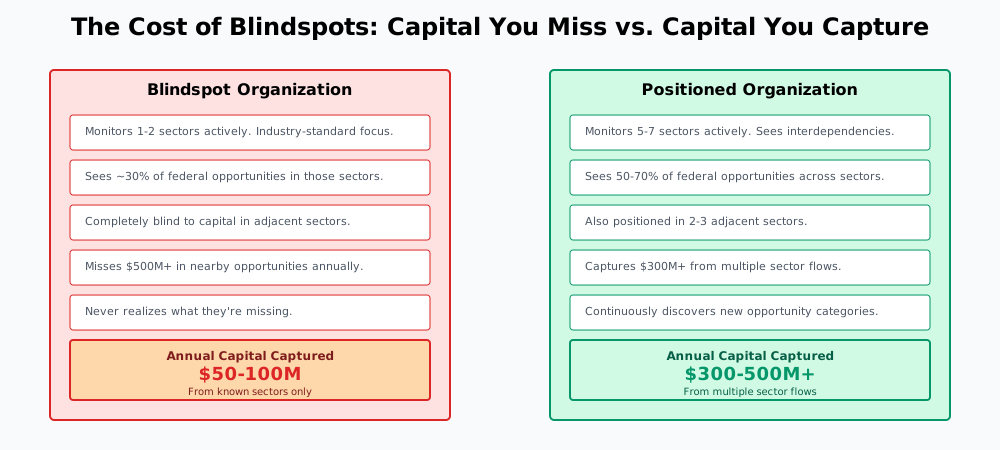
Figure 3: Organizations that audit and eliminate blindspots capture 3-5x more federal capital than those with unaddressed blindspots. The difference compounds every year.
A blindspot organization:
- Monitors 1-2 sectors actively (their core business areas)
- Sees approximately 30% of opportunities in those sectors (misses many because they're not connected to networks)
- Is completely blind to capital flowing in adjacent sectors
- Misses $500M+ in nearby opportunities annually
- Captures $50-100M in federal capital annually (from their known sectors)
A positioned organization:
- Monitors 5-7 sectors actively and understands interdependencies
- Sees 50-70% of opportunities across sectors through active monitoring
- Is positioned in 2-3 adjacent sectors where their capabilities apply
- Captures $300M+ from multiple sector flows
- Continuously discovers new opportunity categories
The annual difference: 3-5x more capital captured. Over 5 years, that's $1.25B+ in additional federal funding that positioned organizations capture while blindspot organizations never see.
Real Examples of Blindspot Elimination
Example 1: Workforce Development Nonprofit focused on manufacturing job training. Discovered federal AI infrastructure funding. Adapted their training model for AI data labeling and infrastructure roles. Captured $25M in federal grants over 4 years. Their capabilities hadn't changed. They just expanded their aperture about where those capabilities apply.
Example 2: Software Company serving enterprise IT. Realized they could serve broadband infrastructure deployment planning. Retrained a team. Won $15M in state broadband deployment contracts. Again, they didn't develop new capabilities. They recognized existing capabilities apply in an adjacent sector.
Example 3: Manufacturing Firm serving traditional industrial sectors. Audited the CHIPS Act and discovered they could manufacture components for semiconductor fabs. Repositioned entire business. Captured $100M+ in CHIPS-related contracts over 2 years.
None of these organizations developed new capabilities. They eliminated blindspots and realized their existing capabilities were valuable in adjacent capital deployment sectors.
Building a Blindspot Elimination Infrastructure
Systematic blindspot elimination requires three things:
1. Continuous Monitoring of All 7 Sectors
You can't discover blindspots without visibility. This is where a Capital Event Intelligence system becomes essential. Your digital employees monitor all 7 sectors continuously, alerting you when capital starts flowing in sectors you wouldn't naturally track.
2. Regular Cross-Sector Audits
Quarterly, ask: "Where are we positioned? Where are we blind? Have any new opportunities emerged in sectors we haven't considered?" This keeps blindspots from accumulating.
3. Strategic Positioning in Emerging Sectors
Once you identify a blindspot you could address, make deliberate moves: hire expertise, build network relationships, develop case studies, position yourself as a vendor in that sector. Over 12-18 months, you move from blind to positioned.
The Compounding Advantage of Eliminating Blindspots
Organizations that eliminate blindspots early gain cumulative advantage:
- Year 1: Discover adjacent sector. Capture first opportunities. Build case studies.
- Year 2: More visibility in sector. Relationships deepen. Win rate increases.
- Year 3: Now positioned as established vendor in that sector. Larger opportunities available.
- Year 4-5: Additional adjacent sectors opened as you see even more interdependencies.
Organizations that don't address blindspots stay trapped in their original sectors, missing the 3-5x capital multiplier that positioned organizations enjoy.
The Decision: Audit Your Blindspots or Accept Limited Capital
$2.5 trillion is flowing right now into 7 federal capital deployment sectors. Your organization is positioned in some of them. In others, you're completely blind—missing opportunities that are available if you could see them.
The audit isn't quick. It takes 2-3 weeks for most organizations. But the ROI is enormous. Most organizations discover 1-3 sectors where they're positioned to capture capital but currently aren't—and that represents hundreds of millions in available federal funding.
Organizations that conduct this audit now and position themselves in adjacent sectors over the next 12-18 months will compound their capital capture for the next 5 years. Organizations that don't will remain blind to 50%+ of the federal capital available to them.
Conduct Your Blindspot Audit
Most organizations discover 1-3 sectors where they're positioned to capture federal capital but currently aren't. We help you identify your blindspots and map the adjacent sectors where your capabilities apply.
Start Your AuditFree Claude Skill assessment. Identify which sectors you're blind to and what positioned organizations are capturing.
Get Your Score — $1,500Includes blindspot gap analysis across all 7 sectors.